Friday, 24 May 2013

Artist Profile: Warwick Fuller

One of the best known contemporary landscape painters of the Capertee Valley is the Little Hartley-based artist Warwick Fuller. Warwick has been painting for over 35 years and has had over 60 solo exhibitions. Like the pioneer Capertee Valley painter Robert Johnson (1890-1964) before him, Warwick is a Fellow of the Royal Art Society of New South Wales (FRAS). Below, Warwick writes of his long standing affinity with the landscape of the area and touches on the technical difficulties of being a plein air painter.


Warwick Fuller in his studio with Afternoon sun, Glen Davies

The Capertee Valley was one of the first truly awe inspiring locations in which I painted. That was back in 1976, two years before I started painting full time. I was vaguely mindful of the history of great artists who had made their way into the ramparted protection of this magnificent triassic basin. Robert Johnson, Reg Campbell, Doug Sealy to name a few.


Though I try to not wear out my enthusiasm for this iconic geological marvel, I am drawn back at least once most years. Early on Allan Fizzell and I would camp on the Dunville loop or down near Glen Davis, painting for three or four days at a time. On one trip, when it was raining, I went to Mr Wilson's property 'Tambo' to introduce myself and ask if I may see his Robert Johnson painting. As I pulled up at his gate a flash of late afternoon sunlight broke through. I was out of the van and painting in a flash. A day or two after, I did get to meet Mr Wilson and see that 'Johnson'.

Another early highlight for me was when painting with Robert Simpson in the Valley. Bob painted a little study of morning light that absolutely knocked me out. Along with other early influences, I think that painting unconsciously started my career long struggle to capture the light. I've painted standing in the river during heat waves, I've perched precariously on sandstone cliffs and on car roofs, on steep slopes, in front of mobs of herded cows. I've painted in frosts where the brushes fell out of my hands because of frozen fingers. Rocks have been required to hold my easel down in wind. Flies have tried to carry me away or rearrange my paintings. But it is the enduring joy of being witness to the marvellous light it the valley. The blazing direct summer light on the bluffs, the gentle filtered winter light on pastures and cattle, the long strafing shadows across the valley floor, the reflected glow as the sun dips below the rim.


Change in the Valley (2010), oil by Warwick Fuller

Many artists travel to 'Capertee' these days and their efforts and interpretations are introducing the wider public to this amazing jewel of the Australian landscape. I've seen many changes over the last thirty seven years but the grand valley remains largely unchanged and undiminished. If nurtured by those who care, and we all remain vigilant, our grandchildren will enjoy its beauty as did our grandparents. Other as yet unborn great artists will surely find inspiration here and masterpieces will be created.


For more information about the artist please refer to Warwick Fuller's website: http://www.warwickfuller.com/


Wednesday, 8 May 2013

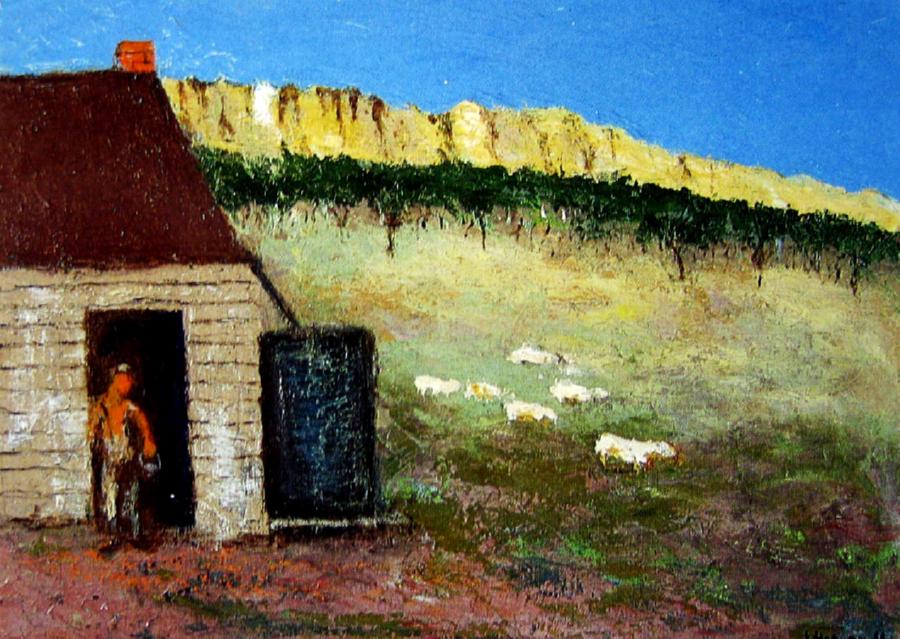
Jack Dawes's cat


The Capertee district has attracted some eccentric types over the years. One such individual was Jack Dawes who lived in the area during the 1930s, 40s and 50s. Jack was a man of very humble means who lived in a water tank in Capertee. His impecunious lifestyle soon attracted the attention of the local police who charged him under the (now repealed) NSW Vagrancy Act. We will leave a newspaper report in the Goulburn Evening Post, of Monday 11th June 1951, to explain the odd details of the case.

The Hermit, Capertee Valley (1988), oil by Sali Herman
image courtasy AASD website
Vagrant Wore Live "Fur" To Keep Warm

A 58-year-old man charged with vagrancy had to be stripped of a large black tom-cat which he claimed he wore to keep him warm when he appeared in Capertee Court of Petty Sessions. The man, Jack Dawes, of Capertee (near Lithgow) was sentenced to three months hard labour.

When Dawes was taken into court, police noticed a large bulge inside his old shirt. Asked what it was, Dawes put his hand into his shirt and pulled out the head of a large tom-cat. He objected when police ordered him to remove the cat in court. He stated that he wore the cat there to keep him warm. He had had the animal for 15 years. The cat was taken from him. After Dawes had been sentenced, Mr. K. Dash, S.M., commented: "I think we'll send the cat with him too. I'm sure we can find a warrant card for it somewhere."

Dawes pleaded not guilty to a charge of having insufficient support. When asked in court how he lived, he commented: "Ben Chifley keeps me!" Apparently Mr. Chifley's patronage was not enough to convince Mr. Dash. He convicted Dawes who was later taken to Lithgow police station. He was then transferred to Bathurst.

Police stated that he lived in a tank in the Capertee district. He had the tank sealed and had to crawl into it through a small hole. Only food stuff which he had with him was cat's meat. He was anxious to take the cat with him.

Some months ago, Det. W. J. Heron, of the Lithgow Police visited the "home" of the accused. He was surprised when Dawes ran-out and sprayed him with eau-de-cologne, explaining that he always kept the perfume on hand for friends.


A big thank you to J. O'Shea, a distant relative of Jack Dawes, for sharing this quirky tale. She believes that her relative died in 1960. In the absence of a photo of Mr Dawes we have reproduced a work by the famous Swiss-born Australian artist Sali Herman (1898-1993), titled 'The Hermit, Capertee Valley'.

Wednesday, 1 May 2013

An aerial mystery

In Bruce Jefferys' local history, The Story of Capertee,  a shot of an early aeroplane flying over a hilly bush landscape was reproduced. The image was titled 'Wolgan Valley' and Jeffreys' credits the photo to local photographer Henry (Harry) Mow who was active in the Capertee area during the early years of the last century. On first inspection Mow's photo looks like a tricked-up image, and this was certainly the view of Jefferys. Fake montages of more than one image to create a new composite picture is a common trick used throughout the history of photography. While this undated image is most likely a montage the photo, possibly, refers to early local contact with aeroplanes in the area.


Henry Mow photo of an aeroplane over the Wolgan Valley

In early March 1926, the Windsor and Richmond Gazette reported on a aerial survey of the Capertee district by the Richmond-based aviator Captain Percival that had taken place a week earlier in late February.  According to the report Percival, along with a surveyor and a photographer, left Mascot at 9.30 am in an Avro aeroplane to undertake a preliminary photographic survey of about 50 square miles of 'very rough country several miles beyond Capertee'. According to the report, the survey would reveal the contours of the area to help guide 'the men who, later on, will go over the ground with axe and "jigger" '.

Captain Percival's flight across the mountains, against a stiff westerly wind, took two and a half hours while the return journey took less than an hour. The party returned to Mascot aerodrome at 5pm. There is a suggestion in the newspaper report that the plane may have landed near Capertee during its mission.


A 1935 photo of Edgar Percival
courtesy Wikipedia

The pilot mentioned in the report was the Australian air pioneer Edgar Wikner Percival (1898-1984). Percival first took up flying during the Great War when he joined the British Royal Flying Corp. After the war he returned to Australia with three surplus aircraft, two Avro 504's and a de Havilland DH 6  to do stunt flying, film work and charter flying. During the 1920s he was known to be doing survey work in Australia, and it was during this part of his career that he surveyed the Capertee district.

While the planes being used by Edgar Percival in the early 1920s were bi-planes they were far more modern in design than the aircraft pictured in Mow's Wolgan Valley photo. The aeroplane pictured in his image seems to be an early aeroplane, most likely designed before the Great War. An Internet search soon discovered an image of a biplane flown by Orville and Wilbur Wright which seems very similar to the aircraft shown in Mow's photo. Being such a famous aircraft it is most likely the source of the tricked up image by Mow.

A biplane flown by Orville & Wilbur Wright

By coincidence Captain Percival's aerial survey of the Capertee district in late February took place just a week after Mow died. Because of this, Mow's image cannot have depicted Percival's survey plane of 1924. So either the image commemorates an earlier flight in the area,  or may simply be an experiment in trick photography.

Please let us know if you can identify the aeroplane seen flying in Henry Mow's photograph or can suggest where Percival may have landed in the Capertee area during his 1924 mission.

Link to Wikipedia entry on Edgar W Percival http://en.wikipedia.org/wiki/Edgar_Percival

In later posts we will look at Harry Mow's career and also highlight the work of other photographers of the district.

Friday, 19 April 2013

Ritchey Sealy: landscape painter

One contemporary painter inspired by the Capertee district is Ritchey Sealy. Ritchey has been painting for thirty years and learnt his craft from his father, uncle and older brother. While mostly known for his images of the far South Coast of New South Wales he has also painted around other parts of the state including the Central Tablelands.

Stacks at Glen Alice, oil by Ritchey Sealy
image courtesy of the artist

Ritchey was born in Forbes, NSW, in the early 1960s but has lived on the South Coast for many years, residing in the small town of Bodalla close to picturesque hills, beaches and lakes. His studio at Bodalla also acts as a gallery where he sells his work. Ritchie paints mainly outdoors in the French landscape tradition known as en plein air (which translates as 'in the open air').


Artist Ritchey Sealey in his Bodalla studio

He is a fast painter and does not rely on photographs as many other landscape artists increasingly do. Generally, most works take about 3 hours to paint on site with only minor finishing taking place in his studio. Ritchey was 'awe struck' by the Capertee Valley when he first visited and has since painted about 30 works inspired by the Glen Davis and Glen Alice sections of the valley.


Road to Dunville Loop, oil by Richey Sealey
image courtesy of the artist

Ritchey Sealy has won several regional art prizes and his work is included in the Queensland Gallery of Modern Art collection. One of his works was presented to the Duchess of York.

For more information about Ritchey Sealy's work please refer to his website.
http://www.ritcheysealy.com.au/

In future posts we will highlight the work of other contemporary artists inspired by the Capertee district.

Sunday, 14 April 2013

Local Plants: Mistletoe - friend or foe?

One of the most fascinating group of plants growing in the Australian bush is mistletoe, and they are often found growing on native trees throughout the district. These plants are sometimes perceived as worthless parasites that weaken trees prior to their death. While this is partially true their value to our environment has been underestimated. Recent research on these highly evolved native plants has led to a reappraisal of their importance to the ecosystem.

The nectar from this local mistletoe flower
 attracts a diverse range of birds, bees and butterfly's

Mistletoe's are a world-wide group of plants which are found in many different habitats. Most early settlers would have known the European Mistletoe (Viscum album), a commonly seen plant culturally associated with pagan fertility rights.

Australia has 85 species of mistletoe, mostly from the Loranthaceae plant family. There are many different species of mistletoe growing in the Capertee district. Most local mistletoes are found growing on open forest and woodland trees such as Eucalyptus, wattles and She-oaks. While most mistletoes photosynthesise from their own leaves they are usually dependent on the hosts sap for water and nutrients.

Mistletoes are often seen growing on trees near the edge of woodland along roads or near cleared land. A 2004 study by ecologist David M Watson near Albury found that 80% of trees growing along habitat edges carried mistletoe compared with fewer than 5% in the interior.The reason for their preference for habitat edges was, according to Watson, related to increased light, decreased fire frequency, increased run off from roads and decreasing numbers of mistletoe eating animals such as possums and gliders at habitat edges. These environment factors have subsequently led to these plants being abundant on the edges of woodland.

While the presence of mistletoe can have a negative affect on the health of the host tree these plants certainly attract a wide range of animals. Associate Professor Watson found that the presence of mistletoe increased the abundance of bird species by 20% or more when compared to similar bush where the mistletoe had been removed. Watson is of the view that the presence of these well adapted plants is 'one of the key factors allowing our woodland-based animals to survive in what's left of their habitat.'


A drooping mistletoe growing on the left
side branch of a local roadside eucalypt
Many birds, animals and insects feed on the flowers, fruit and leaves of mistletoe. Our best known local bird the Regent Honeyeater likes to feed on the nectar and is also known to use the plant as a nesting site. Other birds found feeding on mistletoe include parrots, Eastern-Spinebills and of course the tiny Mistletoebird which feeds on the sticky fruit of the plant. The spreading of the sticky seed by the Mistletoebird is the principal way that new mistletoe plants grow on other host trees. These plants are also important food plants for bees, butterflies and Christmas beetles.


References and further reading

Misunderstood Mistletoe by David M Watson, published in the March 2004 issue of Wingspan magazine


Mistletoes of Southern Australia by David M Watson, CSIRO publishing 2001 (recommended by us)

The Australian National Botanic Garden in Canberra has a fascinating mistletoe web site which will be of interest. http://www.anbg.gov.au/mistletoe/


Thursday, 4 April 2013

Slippery Jack the bushranger

While these days the Capertee district is mostly a law abiding place things were often different in the past. One noteworthy criminal was Slippery Jack a bush-ranger who ran amok robbing local miners huts and sheep stations during the mid-1890s. While the main period of bush-ranging in Australia had passed a generation or two earlier, the hunt for Slippery Jack generated much press attention around the country.

1896 police photographs of the bushranger known as Slippery Jack

From about 1894 reports began to appear of a number of thefts of unattended homes in the local area. In August 1895 the Bathurst Free Press & Mining Journal reported on four robberies of unoccupied miners huts at Palmers Oakey and a bush-ranger daubed 'Slippery Jack' was the main suspect. The paper reported that he got away with some gold, silver, food and supplies.

In February 1896 Slippery Jack's bush camp was discovered by a settler named William Hutchinson at Eagle Hawk's Nest at a deserted high spot near the Sunny Corner to Wattle Flat road. Hutchinson called the police who later attempted to interview the suspected robber at his camp. Slippery Jack tried to shoot at the police but his gun was not loaded. After pelting the police with rocks he escaped into the bush. Not long after a local miner's hut was robbed of all his possessions.

Slippery Jack's bush hut was built of poles and brushwood and covered with bark cut from local trees. Searching his, now abandoned, hut the police found stolen goods including clothing, tents, watches and food. Surrounding his well disguised shelter was a small well cultivated garden consisting of tomatoes, pumpkins potatoes and other vegetables. By this time Slippery Jack was now suspected of being a convict from the French penal settlement of New Caledonia.

After evading capture Slippery Jack relocated up the Turon River, and while there he robbed miners huts. The police were now actively searching for him, and with the aid of Aboriginal trackers traced him to Blackmans Crown in March 1896, but, again, he evaded capture.

On 23 May 1896 Slippery Jack was finally arrested after being shot in the thigh by Constable Preston of Ilford along with several other officers and an Aboriginal tracker named Hughey. The capture took place on Genowlan Mountain, east of Capertee, and according to Bruce Jefferys, writing in The Story of Capertee, Slippery Jack was carried down the mountain to Airly homestead. He was then taken by rail from Capertee to Wallarawang for medical treatment, after which he was sent to Bathurst Police Station.

Despite hardly speaking any English, during formal questioning it became known that the prisoner was a Spaniard who was born in 1834, and he went under several names including Jean Lefung and Juan Larosa. He confessed that he was an escaped convict from the French penal settlement at New Caledonia. He, along with several other prisoners, had escaped from the French colonial prison by boat. To support this story it was noted that the prisoner had marks on his legs caused by leg irons. It seems that our fugitive was a wharf labourer who had been convicted of hard labour for life in France in 1883 for counter-fitting offences before being sent to New Caledonia.

Slippery Jack was found guilty at Bathurst Court for 'breaking and entering a dwelling and house stealing within' and was sentenced to 5 years imprisonment. Considering his many, alleged, offences in the district the prisoner escaped with a relatively light sentence. Despite this, later that year he attacked another inmate and received an extra years imprisonment for malicious wounding. It is not known what happened to Slippery Jack after his time behind bars.

If you have information to add to this article we would love to here from you.


Tuesday, 12 March 2013

The greatest wonder in the world


‘The greatest wonder of the world’ was the description given to the world’s largest specimen of reef gold which was discovered by Bernhardt Holtermann at nearby Hill End in 1872. Within months of the find the mining settlement was transformed into one of the largest inland towns in New South Wales. But, by the 1880s most of the gold had been found and the community went into terminal decline. Apart from contemporary press reports little was known of the appearance of Hill End until a large cache of glass plate negatives were discovered in a garden shed owned by the Holtermann family in Chatswood in 1951.


Hand coloured photo of James Jaye's
tinsmith shop in Bathurst (1873)
Holtermann collection, State Library of NSW

It soon became apparent to historians that these 3,500 negatives – known as the Holtermann Collection - were the work of travelling photographers Beaufoy Merlin and Charles Baylis of the American and Australasian Photographic Company who visited Hill End and other Central Tablelands mining towns in the early 1870s.


Short Street, Hill End (1872) 
Holtermann collection, State Library of NSW

Recent developments in computer digital imaging have allowed the State Library of NSW to scan the Holtermann Collection images so they can be clearly enlarged to gallery size prints. A sample of these astonishing images is now on view at the State Library of New South Wales in Macquarie Street, Sydney, until 12th May 2013. Works at The greatest wonder of the world show include house and street scenes of Sydney, Bathurst, Hill End and Gulgong. There are also images of other local mining communities such as Home Rule and Canadian Lead.

As well as the images of the mine workings and the townscapes there are also many studio portraits  of the diverse residents of these communities. These include family portraits as well as images of children. My favourite child portrait is of a bewildered looking boy named August Gondolf who is seated on a tricycle. One sad image is a post-mortem photograph of an infant girl laid out with flowers in preparation for her funeral.


Studio portrait of August Gondolf
Holtermann collection, State Library of NSW
This exhibition will delight all with an interest in nineteenth century Australian history. Make time to visit this free exhibition next time you are in Sydney.


Exhibition opening hours:
9 am to 5 pm Monday to Thursday (Tuesdays open until 8 pm), 9 am to 5 pm Friday, 10am to 5 pm weekends
Closes 12th May 2013


Related Posts Plugin for WordPress, Blogger...